
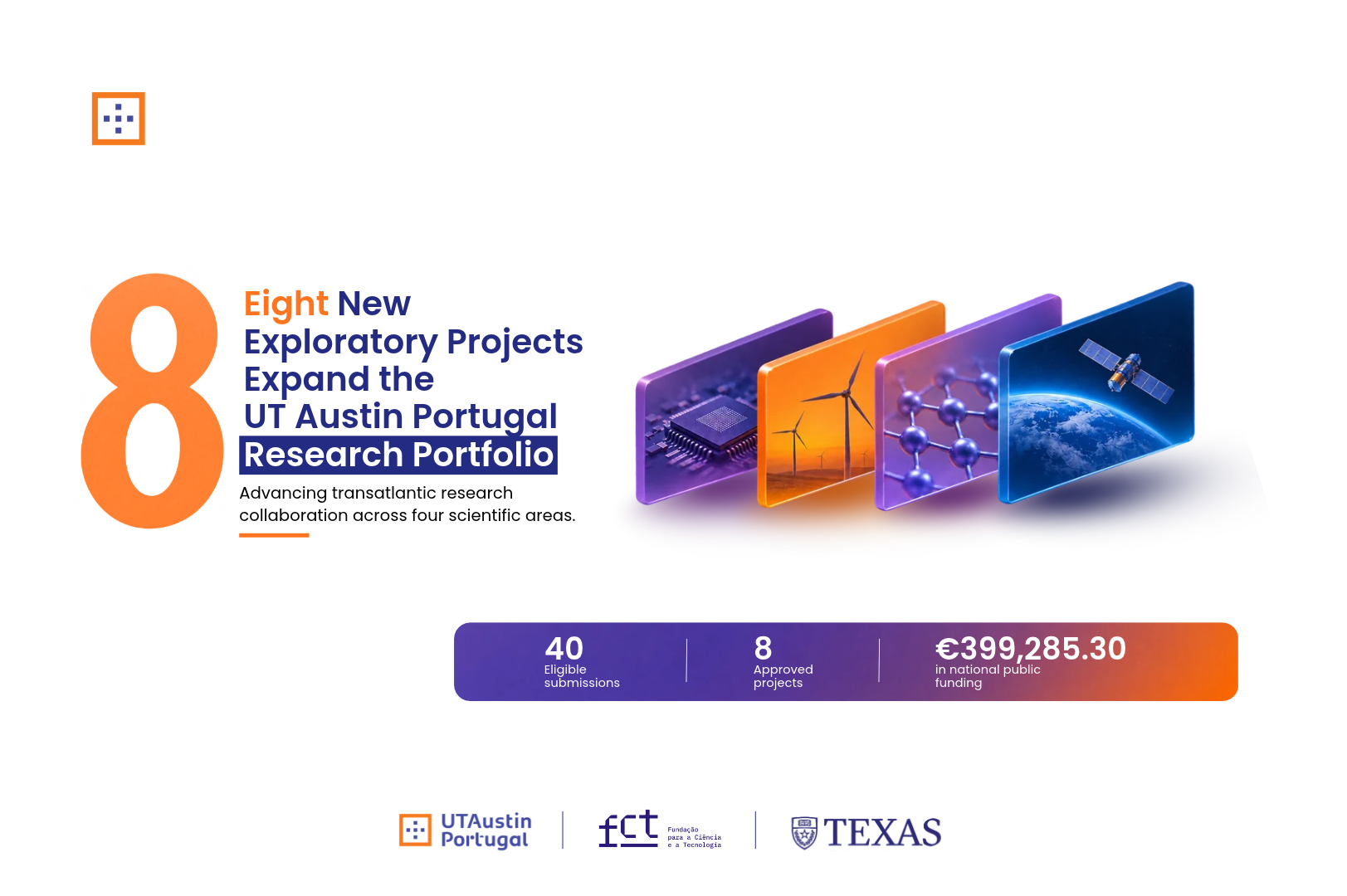
From new approaches to glioblastoma treatment and next-generation communications to carbon capture, flood analysis and human–robot interaction, eight new exploratory research projects have been selected to advance collaboration between Portuguese research teams and The University of Texas at Austin.
The projects were selected under the 2025 Call for Exploratory Research Projects of the UT Austin Portugal Program, promoted by the Foundation for Science and Technology (FCT).
Out of 40 eligible applications, eight projects were recommended for funding by an independent evaluation panel appointed by the Program’s sponsor. These projects represent a 20% approval rate and €399,285.30 in national public funding for the participating Portuguese teams.
Complementing the €399,285.30 in national public funding awarded to the Portuguese teams, the Program’s budget at UT Austin commits up to $800,000 to support UT Austin research teams working with their counterparts in Portugal and to enable researcher mobility as the projects unfold.
Together, the selected projects extend the Program’s Phase 4 research portfolio across all four scientific areas: Advanced Computing, Clean Energy, Nanotechnologies, and Space–Earth Technologies.
Five projects fall within Nanotechnologies, while Advanced Computing, Clean Energy, and Space–Earth Technologies are each represented by one project.
Beyond those numbers, however, the portfolio reflects a much wider range of scientific questions.
Different Fields, Shared Research Ambition
The new projects explore challenges at very different scales, from technologies designed to interact with the human body to systems addressing communication, energy, climate, and intelligent machines.
Within Nanotechnologies, the selected projects span biomedical applications, advanced materials, communications, and technologies supporting the energy transition.
Led by Bruno Sarmento at the University of Porto, in collaboration with Huiliang (Evan) Wang at UT Austin, FUS-GBM explores new approaches to localized drug delivery for glioblastoma.
Led by Elvira Maria Correia Fortunato at NOVA University Lisbon, in collaboration with Brian A. Korgel at UT Austin, TEXTRONICS explores smart textiles, flexible electronics, and new sensing functionalities.
Led by Jonas Deuermeier at NOVA University Lisbon, in collaboration with Deji Akinwande at UT Austin, BLOCK-6G looks toward future wireless communications through work involving memristors, two-dimensional materials, and high-resolution printing.
Led by Helena Prado Felgueiras at the University of Minho, in collaboration with Jonathan Y. Chen at UT Austin, SmarTEND explores new biofunctional materials and fibrous architectures for tendon repair.
Led by Andrea Capasso at the International Iberian Nanotechnology Laboratory, in collaboration with Narayana R. Aluru at UT Austin, NanoFREE investigates approaches to rare-earth element separation and ion transport with potential relevance to green hydrogen technologies.
From Carbon Capture to Intelligent Robots
The portfolio extends beyond Nanotechnologies into three other areas central to the Program’s Phase 4 strategy.
Led by Abeer Al Mohtar at Instituto Superior Técnico, in collaboration with Brian A. Korgel at UT Austin, INICCU will explore advanced nanomaterials for integrated approaches to capturing and using carbon.
Led by Miguel Azenha at the University of Minho, in collaboration with Fernanda Leite at UT Austin, AccuraFlood focuses on the use of remote sensing, aerial data, and digital information to support flood analysis at regional scale.
Led by Bruno Emanuel da Graça Martins at INESC-ID, in collaboration with Peter Stone at UT Austin, EXPLOR-HODOR explores human–robot interaction and embodied reasoning, including the use of foundation models and large language models in domestic robotics.
Taken together, the eight projects show how exploratory research can connect very different scientific domains while addressing questions with potential technological, economic, and societal relevance.
The portfolio also combines new research leadership with continuity across the Program. Six researchers will serve as Principal Investigators under the UT Austin Portugal Program for the first time, while two PIs have previously led Program-supported projects. This mix brings new researchers into the Partnership while building on experience and collaborations already developed through the Program.
Research Built Across the Atlantic
At the center of each project is a research partnership connecting a PI in Portugal with a PI at UT Austin, supported by complementary resources on both sides of the Atlantic.
The 2025 call was designed to create the conditions for Portuguese and UT Austin researchers to jointly pursue exploratory ideas with high risk and high potential impact, while building foundations that may support more ambitious research in the future.
Alongside the national public funding awarded through FCT, the Program’s commitment at UT Austin will support the participating UT Austin teams and enable researcher mobility as the projects unfold. This support is intended to create opportunities for researchers to work across institutions and strengthen the collaboration between the teams in Portugal and Austin.
The selected portfolio connects Portuguese institutions, including the University of Porto, NOVA University Lisbon, University of Minho, International Iberian Nanotechnology Laboratory, Instituto Superior Técnico, and INESC-ID, with researchers and expertise at UT Austin.
These new collaborations add another layer to a Phase 4 research portfolio built around the exchange of knowledge, complementary capabilities, and research questions that benefit from being approached across institutions and across the Atlantic.
As the eight projects begin their work, the UT Austin Portugal Program will continue following their progress and sharing the researchers, ideas, and results emerging from each collaboration.
Selected Projects at a Glance
Advanced Computing
UT Austin PI: Peter Stone, UT Austin
Clean Energy
UT Austin PI: Brian A. Korgel, UT Austin
Nanotechnologies
UT Austin PI: Huiliang (Evan) Wang, UT Austin
UT Austin PI: Brian A. Korgel, UT Austin
UT Austin PI: Deji Akinwande, UT Austin
UT Austin PI: Jonathan Y. Chen, UT Austin
UT Austin PI: Narayana R. Aluru, UT Austin
Space–Earth Technologies
UT Austin PI: Fernanda Leite, UT Austin