
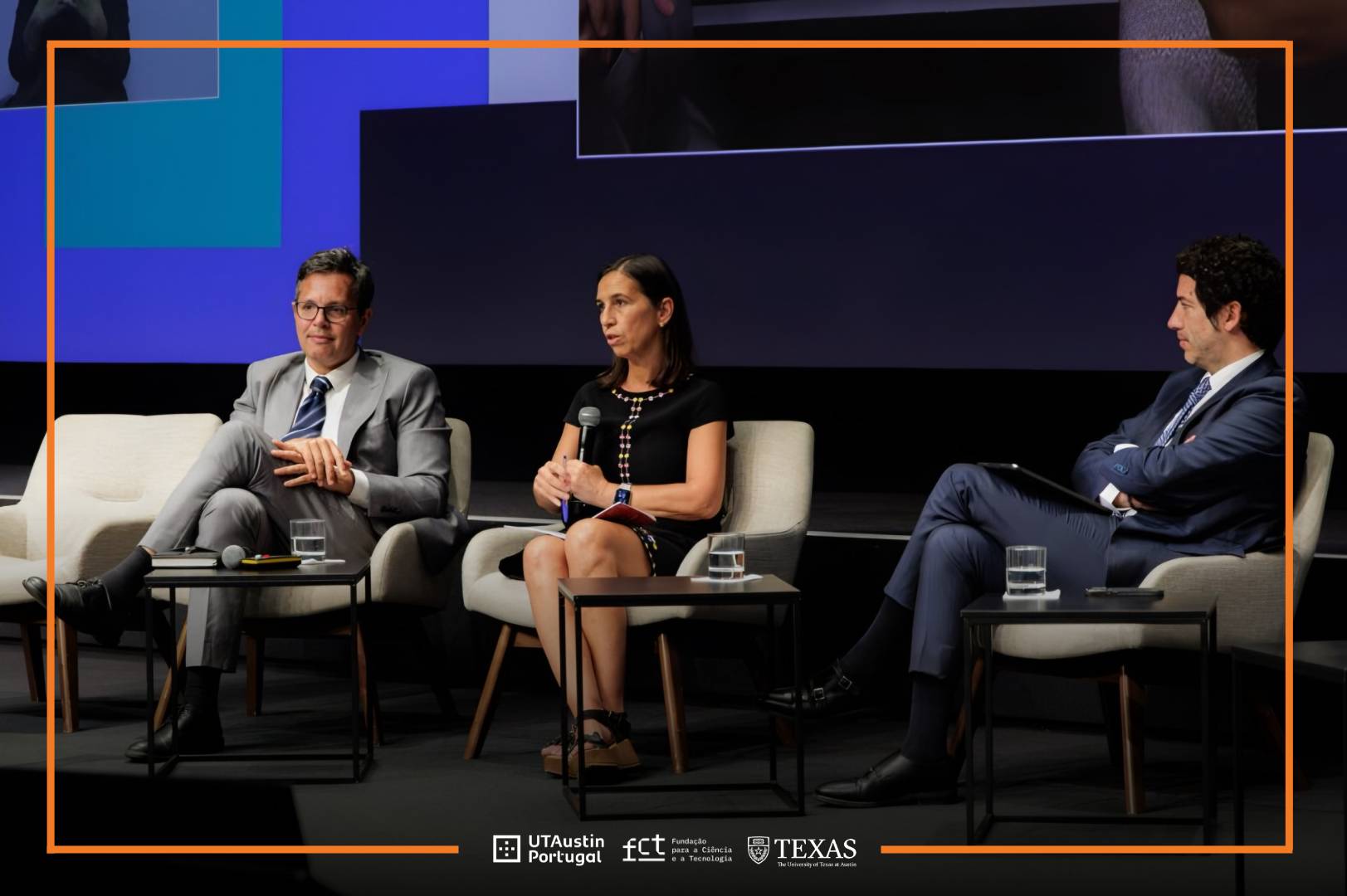
The UT Austin Portugal Program participated in Encontro Ciência e Inovação 2026, contributing to a national discussion on how international scientific partnerships can generate more connected, sustainable, and long-term value for Portugal.
Held on July 15 and 16 at the Lisbon Congress Centre, the event marked the first major national gathering organized by the newly established Agency for Research and Innovation, AI². Under the theme “Preparing for the Future,” it brought together researchers, higher education institutions, companies, entrepreneurs, policymakers, and representatives of civil society to discuss Portugal’s future research and innovation priorities.
The event received 2,350 registrations and was structured around 20 thematic sessions developed from 206 proposals submitted by the scientific and innovation community.
International partnerships as part of a wider national strategy
The UT Austin Portugal Program participated in the first-day parallel session “International Partnerships for Excellence.”
The session brought together representatives from Teaming centres led by Portuguese institutions and the international partnerships established by the Portuguese Foundation for Science and Technology with Carnegie Mellon University, the Massachusetts Institute of Technology, and The University of Texas at Austin.
These initiatives have contributed to strengthening Portugal’s scientific capacity, supporting international research cooperation, developing talent, and connecting Portuguese institutions with leading international universities and research ecosystems.
The discussion looked beyond the individual achievements of each initiative. It focused on how the experience, knowledge, networks, and institutional capacity developed through international partnerships could contribute to a more coherent national research and innovation strategy.
The UT Austin Portugal Program was represented by its National Directors in Portugal, Rute André and Rui Oliveira.
During the session, Rute André explained how the Program’s fourth phase reflects Portugal’s evolution from building scientific capacity to contributing more actively to international research and innovation agendas.
Phase 4 is structured around an integrated approach connecting collaborative research, advanced training, international mobility, technology transfer, and entrepreneurship. The objective is to create clearer pathways through which knowledge generated by Portuguese researchers can produce scientific, societal, and economic value.
Connecting the different stages of the innovation pathway
The Program’s contribution raised several questions that are central to the future of international partnerships.
How can collaborative research, advanced training, researcher mobility, knowledge valorization, and entrepreneurship be connected more effectively? How can promising technologies and scientific ideas be prevented from being lost between programmes, instruments, or funding cycles? Are additional mechanisms needed to address gaps between research results, validation, and real-world application?
The discussion also considered how the value generated by international partnerships should be assessed. This includes not only the individual results of projects and programmes, but also their collective contribution to institutional capacity, talent development, international positioning, technology transfer, entrepreneurship, and the broader Portuguese research and innovation ecosystem.
For the UT Austin Portugal Program, these questions are particularly relevant to Phase 4. The Program is working to connect research and advanced training with mechanisms that help teams assess the application potential of their work, engage with international markets and stakeholders, and pursue new pathways toward impact.
Building on two decades of international cooperation
José Manuel Mendonça, Chair of the Mission Structure for the FCT International Partnerships, provided historical context on the creation of Portugal’s partnerships with US universities nearly two decades ago, under the leadership of former Minister of Science Mariano Gago.
His contribution highlighted the long-term value generated by these programmes for Portugal’s scientific and innovation system, including the development of highly qualified people, new research collaborations, institutional relationships, and entrepreneurial initiatives.
The participation of CMU Portugal, MIT Portugal, and UT Austin Portugal in the same session also provided an opportunity to consider their combined experience.
Although each partnership has its own scientific priorities, instruments, and institutional relationships, together they represent a substantial body of knowledge on transatlantic cooperation, international mobility, collaborative research, advanced education, and research-based innovation.
From individual initiatives to a national portfolio of excellence
The conclusions published after the event reinforced the importance of treating international partnerships and centres of excellence as part of a broader and more coordinated national strategy.
Among the proposals emerging from the session were the need for longer-term and more diversified commitments, mechanisms that help successful initiatives bridge different funding periods, stronger integration between national and European programmes, and more agile legal and regulatory procedures for large collaborative initiatives.
Participants also discussed the value of creating a national portfolio for scientific internationalization. Such an approach could connect established partnerships, centres of excellence, research infrastructures, companies, and other stakeholders around strategic national and regional challenges.
The session involved 170 participants and 17 pitches, reflecting the scale and diversity of the organizations interested in strengthening Portugal’s international research and innovation position.
For the UT Austin Portugal Program, participation in Encontro Ciência e Inovação 2026 was an opportunity to contribute its experience to this wider discussion and to reaffirm the role of long-term international cooperation in helping Portugal generate knowledge, develop talent, strengthen institutions, and create value from research.
As Phase 4 progresses, the Program will continue working across research, education, mobility, and innovation to connect scientific ambition with the people, mechanisms, and international relationships needed to support lasting impact.