History
- Home
- History
A long-term partnership evolving with science, society, and global challenges
Since its creation in 2007, the UT Austin Portugal Program has been a long-term strategic partnership between Portugal and The University of Texas at Austin. Over successive phases, the Program has evolved in scope, ambition, and structure – responding to national priorities, global scientific challenges, and the maturity of the Portuguese research and innovation ecosystem.
Across nearly two decades, the Program has combined research excellence, advanced education, and innovation-driven collaboration, building enduring institutional ties and fostering a generation of researchers, educators, and innovators connected across the Atlantic.
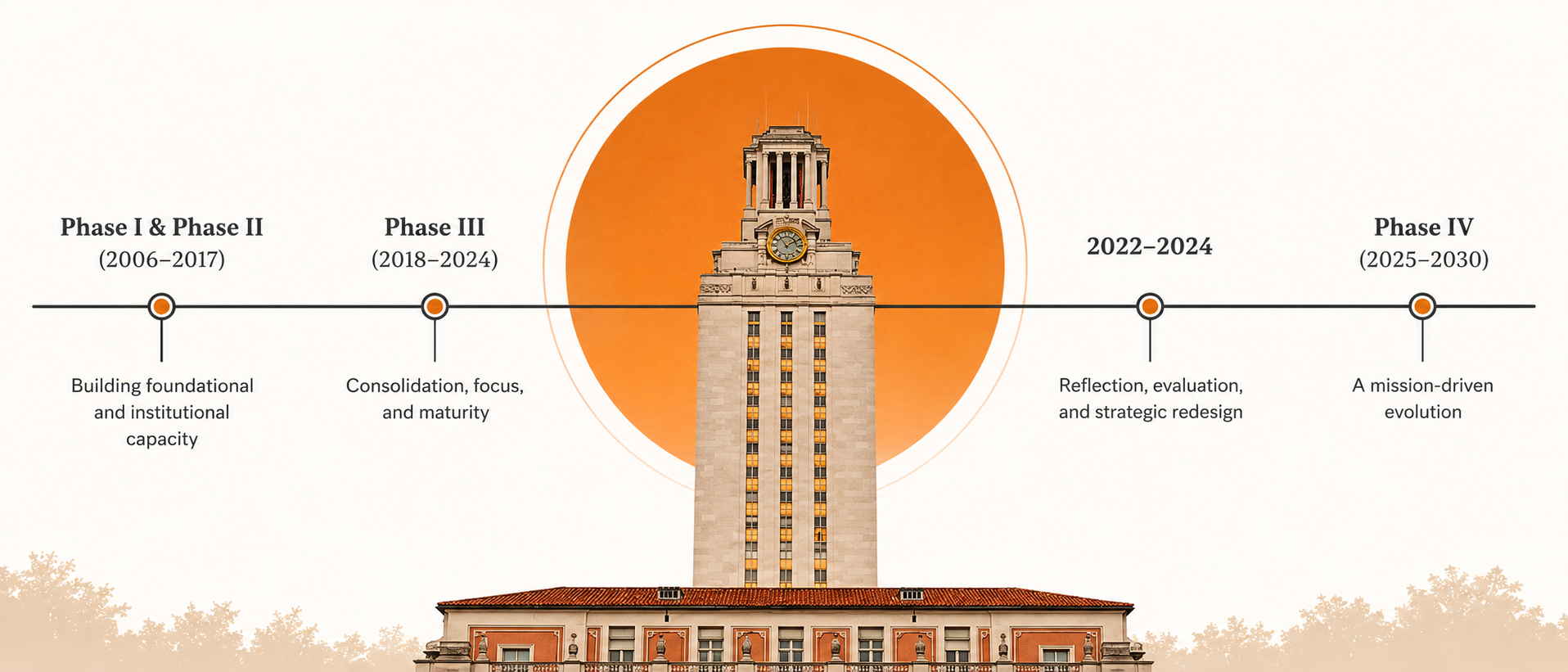
Phase 4 (2025-2030)
A mission-driven evolution
Phase 4 represents a strategic evolution of the UT Austin Portugal Program.
Building on nearly two decades of collaboration, Phase IV adopts a mission-oriented framework, structured around four flagship Research & Innovation areas:
- Clean Energy
- Advanced Computing
- Nanotechnologies
- Space–Earth Technologies
This phase strengthens the integration of:
- Research, through focused, high-impact projects
- Education and training, aligned with research priorities
- Innovation and commercialization, supporting societal and economic impact
Phase 4 also introduces clearer programmatic instruments, enhanced coordination across pillars, and a renewed emphasis on global relevance – while preserving the partnership’s core values of trust, excellence, and long-term collaboration.
Phase 3 (2018-2024)
Consolidation, focus, and maturity
Phase 3 marked a period of consolidation and strategic focus, reflecting the growing maturity of the partnership and of the Portuguese research and innovation system.
The Program concentrated on fewer, more integrated research domains, notably:
- Advanced Computing
- Nanotechnology
- Space–Earth Interactions
- Medical Physics, through collaboration with MD Anderson Cancer Center
This phase strengthened peer-to-peer collaboration, embedded long-term research partnerships, and expanded advanced training and mobility opportunities. Innovation activities continued, while the Program increasingly emphasized research excellence and advanced human capital development.
By the end of Phase 3, the UT Austin Portugal Program had reached a level of maturity that enabled a strategic reassessment of its mission, structure, and long-term impact.
Phase 1 & Phase 2 (2007-2017)
Building foundations and institutional capacity
The first two phases of the UT Austin Portugal Program were designed to build foundational capacity in areas critical to Portugal’s scientific and technological development.
During this period, the Program focused on:
- Advanced education and training
- Early-stage research collaboration
- Technology transfer and innovation capacity-building
Key thematic areas included Digital Media, Applied Mathematics, Advanced Computing, Nanotechnology, and Innovation, with the creation and consolidation of structures such as UTEN (University Technology Enterprise Network) playing a central role.
These early phases laid the groundwork for:
- Strong institutional collaboration between Portuguese universities, research centers, and UT Austin
- The development of human capital with international experience
- The emergence of technology transfer practices aligned with global standards
Consistency Across Phases
While the Program has evolved in structure and focus, several principles have remained constant across all phases:
- A long-term commitment to transatlantic collaboration
- A focus on research excellence and talent development
- Strong alignment with
- Portuguese national priorities and international scientific agendas
- A partnership model based on institutional trust, peer collaboration, and shared responsibility
These enduring elements continue to underpin the UT Austin Portugal Program as it moves forward into Phase 4.