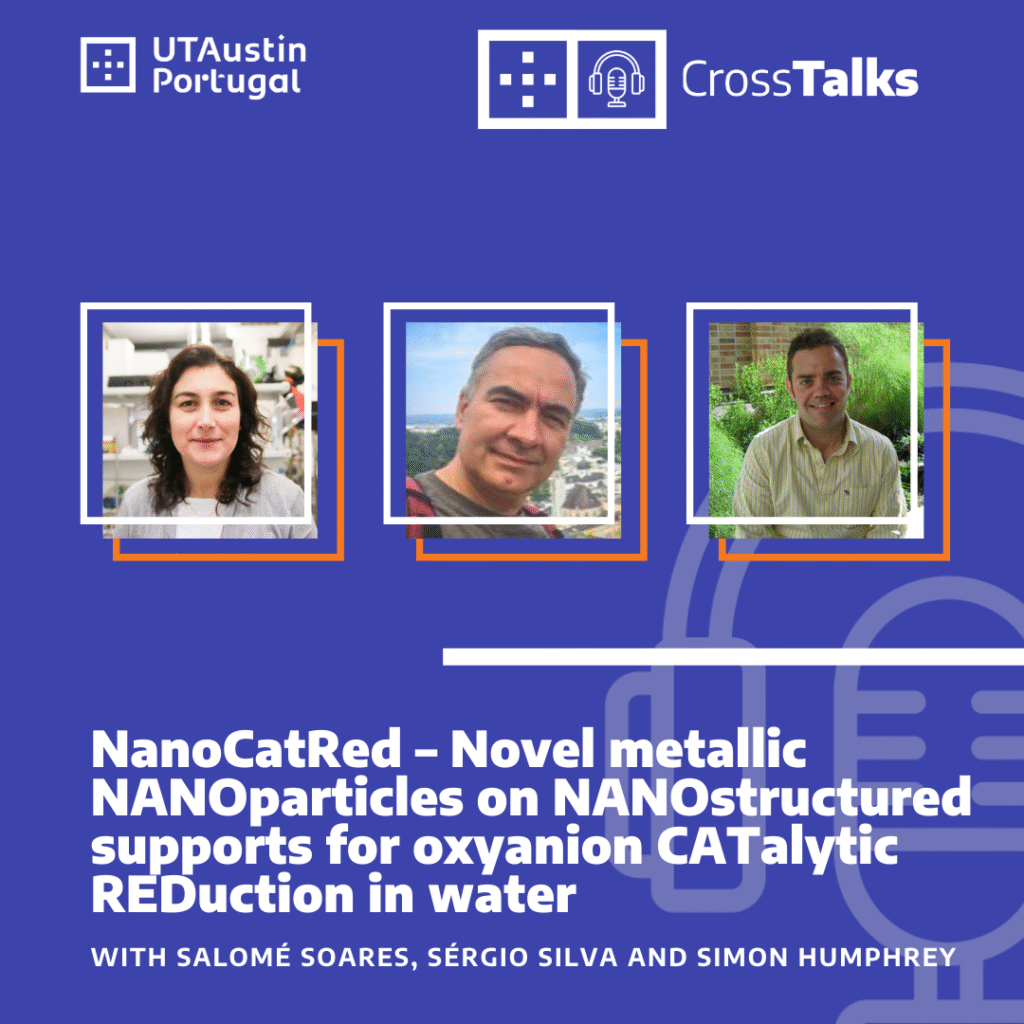
In our eleventh episode Salomé Soares (Assistant Researcher at the Faculty of Engineering of the University of Porto), Sérgio Silva (Founder & CEO of ADVENTECH) and Simon Humphrey (Professor at the UT Austin’s College of Natural Sciences) shared more about their project called NanoCatRed. The group is developing nanoparticles that break down harmful inorganic contaminants, from water. Through a chemical reaction, these nanoparticles generate harmless products, thus reducing the health risks that inorganic contaminants impose on humans and the environment.
In our eighth episode, we talked with Arlindo Marques (Product Manager of the Aerospace Department at Efacec), Clara Lázaro (Assistant Professor at the Faculty of Science of the University of Porto & Interdisciplinary Centre of Marine and Environmental Research), Paulo Figueiredo (Data Scientist at Centre of Engineering and Product Development), and Brandon A. Jones (Assistant Professor at the Department of Aerospace Engineering and Engineering Mechanics at UT Austin) about their project MAGAL Constellation. Together, they explained how one of the biggest consortia is using small satellites to study ocean level variations and climate change.
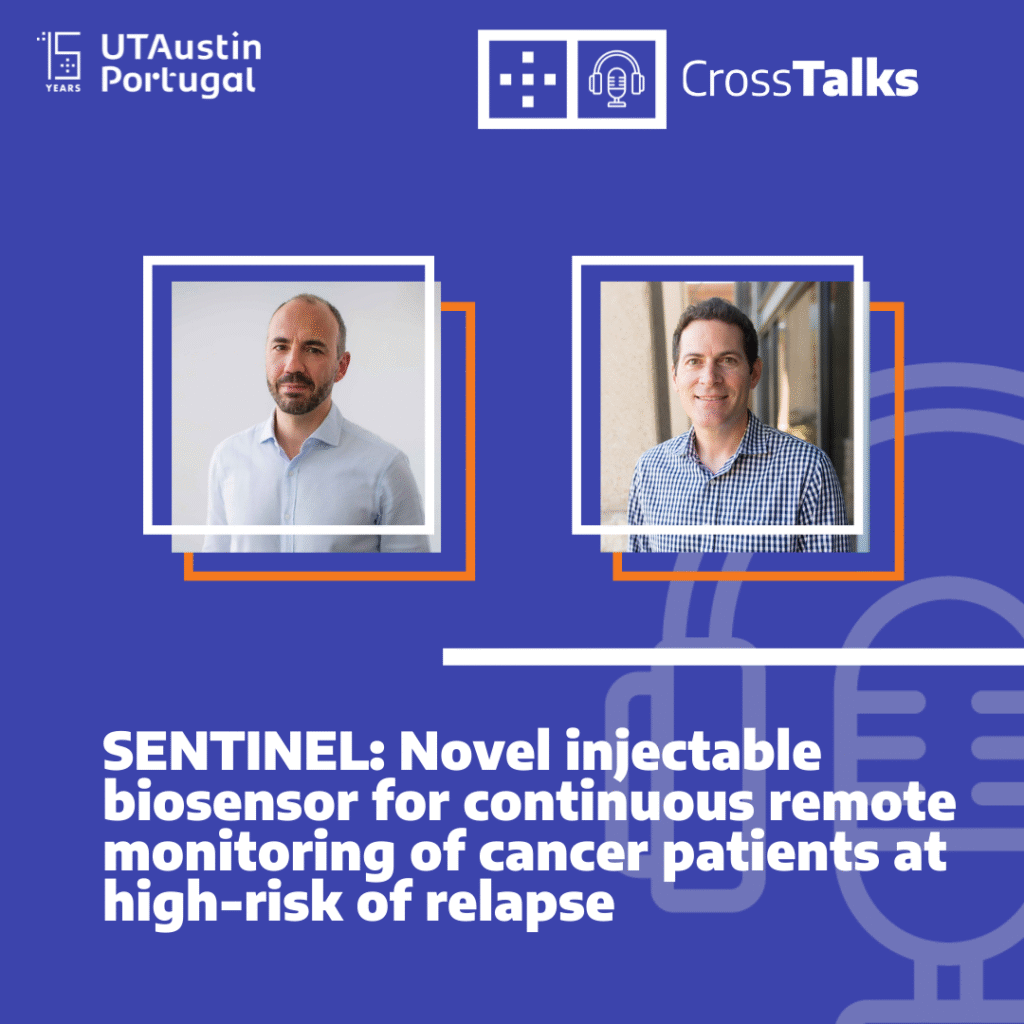
In our seventh episode, we talked with Rui Sousa (CEO at Stemmatters) and James Tunnel (Associate Professor at The University of Texas at Austin’s Cockrell School of Engineering) about their project SENTINEL. Together, they explain how multiple fields of research are collaborating to create an implantable biosensor that can help in the fight against prostate cancer.
In our sixth episode, we talked with Rosa Romero (CEO at Sphere Ultrafast Photonics) and Andrew Dunn (Director of the Center for Emerging Imaging Technologies at the University of Texas at Austin) about their project ExtreMED. Together, they explain how they can use lasers to innovate the microscopy market and observe live tissues with lowered photo-induced damage.
In our fourth episode, we engage in a conversation with Filipe Fernandes (professor at the University of Coimbra), Gregory Rodin (professor at The University of Texas at Austin) and Filippo Mangolini (assistant professor at The University of Texas at Austin). They talked about the research behind the project MCTool21:Manufacturing of cutting tools for the 21st century: from nano-scale material design to numerical process simulation.
In our third episode, we engage in a conversation with Alfredo Silva (Senior Consultant at IncreaseTime), Cláudia Lopes (Researcher at the Center of Physics of the Universities of Minho and Porto) and Nélson Azevedo (Physiotherapist and Physiotherapy Professor at Instituto Superior de Saúde). They explained how nanomaterials could help patients with neuromuscular diseases.
In our second episode, the Program engages in a 20-minute conversation with Stefaan Tavernier (PETsys electronics, Portugal) and Karol Lang (University of Texas at Austin, USA) about the advantages and disadvantages of proton therapy in relation to other existing therapies, its challenges as well as the TOF-PET project’s envisioned solution.
In this first episode, the Program engages in a 30-minute conversation with Todd Evans (TACC, USA), João Paulo (INESC TEC/UMinho, Portugal) and Bruno Antunes (Wavecom, Portugal) about the pervasiveness of the advanced computing area, the High-Performance Computing (HPC) infrastructures, the next generation of HPC supercomputers and the challenges and game-changing nature of BigHPC, a UT Austin Portugal’s Strategic Research Project that cuts across all those topics.