
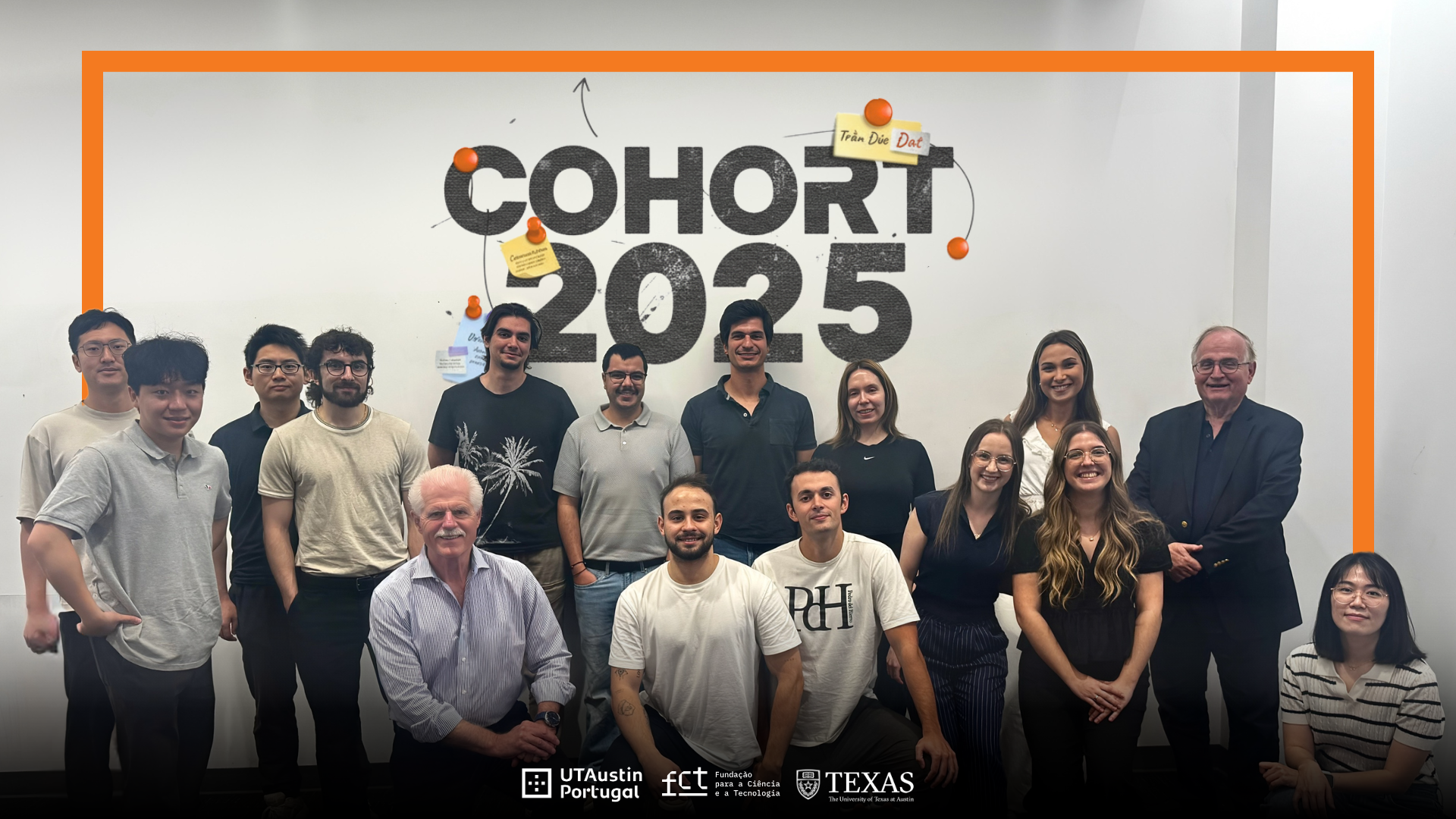
The UT Austin Portugal Program recently held another edition of its Exchange Researchers Seminar at The University of Texas at Austin, bringing together visiting researchers from the current 2025/2026 cohort, who are nearing the end of their mobility period, to present the work developed during their stay and reflect on their experience in Austin.
Hosted by Dr. John Ekerdt, Principal Investigator of the UT Austin Program at UT, the seminar created a space for participants to share research progress, exchange perspectives, and take stock of what their time at UT Austin had meant both scientifically and personally. More than a presentation session, the event also served as a networking opportunity involving visiting researchers, host researchers, and members of the Program’s wider community.
In his opening remarks, Dr. John Ekerdt, described the exchange as an opportunity for researchers to learn from one another, grow professionally, expand their networks, and develop new skills while working on open-ended research problems.
This edition featured presentations by Mafalda Correia, Vicente Lopes, Paloma Toscan, Guilherme Martins, and Afonso Lourenço, whose work reflected the breadth of research being advanced through the Program’s mobility activities. Their projects ranged from biomedical applications and advanced materials to artificial intelligence, remote sensing, and machine learning.
Together, the presentations showed how the mobility experience at UT Austin is helping researchers make concrete progress in their work while gaining access to new expertise, methods, and collaborative environments. Across different fields, a common thread emerged: time spent at UT Austin is not only accelerating research, but also opening new perspectives for future scientific cooperation.
Among the projects presented, researchers discussed work related to new treatment approaches for infected chronic wounds, memristor-based devices with synaptic functionality, the creation of large-scale datasets of urban community gardens using remote sensing and artificial intelligence, and streaming machine learning for dynamic data environments. While distinct in topic, all of the presentations illustrated how international research immersion can support both technical development and broader academic growth.
The seminar also highlighted the value of the experience beyond the laboratory. In materials previously shared with the Program, participants described the opportunity as both professionally meaningful and personally enriching.
As Vicente Lopes noted, his stay at UT Austin represented “a breakthrough opportunity,” allowing him to work with state-of-the-art technology and expand his expertise in ways that will continue to shape the rest of his PhD.
For Paloma Toscan, the Program offered “a unique opportunity to collaborate with leading international researchers and gain exposure to new research perspectives.” Reflecting on the experience, she emphasized not only the technical learning involved, but also the importance of interdisciplinary collaboration and the value of being immersed in a different academic culture.
In his closing remarks, Dr. John Ekerdt said he is “always impressed” by the researchers’ progress, adding that “the progress you’ve made is phenomenal” and that the cohort should be proud of what they had achieved.
These reflections echo the broader purpose of the Exchange Researchers Seminar: to make visible the results of the mobility period while also recognizing the wider impact such experiences have on researchers’ confidence, networks, and future pathways.
By combining scientific presentation with shared reflection, the seminar offered a meaningful snapshot of this cohort’s time at UT Austin and of the role the UT Austin Portugal Program continues to play in strengthening transatlantic collaboration, researcher development, and knowledge exchange.